

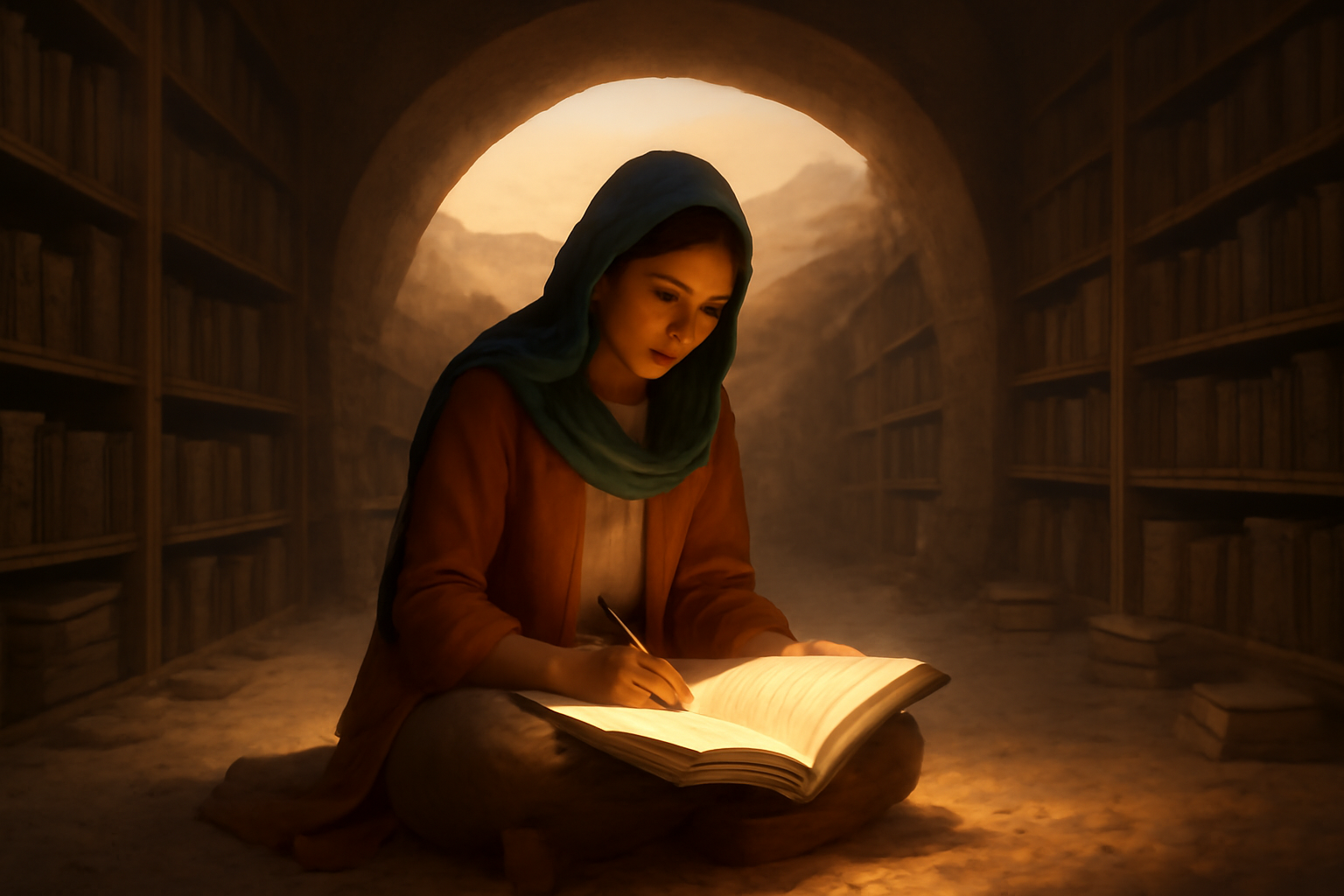
The first time the desert tried to talk to Zahra, she ignored it.
She thought it was only the wind — that peculiar hush that sweeps over the dunes at dusk, when the sun sinks low and the sky turns the color of old apricots. She sat outside her small tent with a chipped enamel mug of tea, watching the sand shift in long, sleepy waves.
The desert sighed.
The dunes whispered.
Her name slid across the air like a secret.
Zahra…
She shivered and pulled her shawl tighter around her shoulders.
“Too many late nights,” she muttered. “Too many old books.”
She was an archivist by trade, a finder of lost stories, hired by the small university in Halim to help catalog whatever the archaeological teams dragged in from the old ruins. Most days it was broken pottery, corroded tools, scraps of text that gave up only phrases.
But she had come along on this particular dig because of a rumor.
Not a scientific rumor. A grandmother rumor.
Her own grandmother, to be specific, who used to tell stories about a Library Beneath the Sand — a place where the desert stored not bones or broken pottery, but stories. A place that did not just keep books.
It wrote them.
“You go collecting everyone else’s words,” her grandmother would say, tapping Zahra’s forehead. “But you never write your own. If you ever find the desert’s library, maybe it will remind you you’re allowed to.”
Zahra had laughed then, brushed it off. But when the field report mentioned an unusual area of magnetic disturbance under a remote dune field — layered like an old city — the memory surfaced like something finally ready to breathe.
So she volunteered.
Packed her notebooks.
Came to the sand.
And now the sand was saying her name.
On the fourth day in the field, the ground changed.
The morning sun cast long blue shadows when Zahra joined the team at the main pit. They had been mapping an anomalous stone ring just beneath the surface — too smooth to be natural, too intact to be anything but intentional.
“Zahra!” called Dr. Kassem, the excavation lead. “Come look at this.”
She hopped down the ladder carefully, boots kicking small avalanches into the pit.
In the center of the ring, the sand was different — finer, paler, almost pearlescent.
“It’s compacted,” Kassem said, frowning. “But the instruments insist there’s a cavity beneath.”
“How deep?” Zahra asked.
He tapped the monitor. “Oddly shallow. Two meters, maybe. Then empty.”
She knelt, running gloved fingers through the pale layer.
The desert exhaled again.
Zahra…
She jerked her hand back.
“Static,” she muttered, though nothing had shocked her.
Kassem studied her. “You alright?”
“Fine,” she lied. “What are you going to do?”
“Carefully be irresponsible,” he replied. “We’re going to open it.”
They worked slowly, brushing away the pale sand in thin, patient layers, until the texture changed again.
Stone.
Smooth. Cool. Etched with something.
Zahra’s breath caught.
Lines curved across the exposed surface, shimmering faintly even in the harsh light. Not like ordinary carvings. These looked almost wet, as if ink had been poured directly into the stone.
She wiped gently with a brush.
Letters.
Not of any script she recognized, yet somehow… readable.
As she stared, the symbols shifted, rearranging themselves into words her mind could hold.
HERE IS THE PLACE WHERE STORIES REST
AND ALSO WHERE THEY BEGIN
Her skin prickled beneath her shirt.
“Kassem,” she whispered, “you should see this.”
He crouched beside her, squinting.
“What does it say?” he asked.
“You… you don’t see it?”
“Just patterns.” He shrugged. “Decorative, maybe ritualistic.”
So it was only her.
The desert, it seemed, had decided to speak to her alone.
She swallowed.
“Maybe we should—”
Before she could finish the thought, the stone beneath her hands warmed.
The carved ring lit up, a soft pulse of honey-colored light racing around the circle, then dropping inward like water down a drain.
The sand inside the ring collapsed.
Zahra yelped as the ground gave way beneath her knees.
She fell.
The fall wasn’t long.
Maybe two meters, just as the instruments had said.
But it felt larger, like dropping through a sigh years in the making.
She landed on something surprisingly soft.
Books.
She lay there in stunned silence, her heart pounding in her ears, the dust settling around her in lazy spirals.
Above, the circle of sky glowed bright — a perfect ring of blue framed by the excavation pit.
“Zahra!” Kassem’s voice echoed from what now felt like very far away. “Are you hurt?”
She sat up, coughing. “I’m—I’m okay! I’m in some kind of… chamber.”
Her words trailed off as she actually looked around.
Shelves.
Row upon row upon row of shelves, stretching out beyond the glow of her flashlight, fading into darkness. The ceiling above them was domed stone, inscribed with constellations that slowly shifted, mirroring the sky outside.
And everywhere — on floor, on shelves, stacked in little careful towers — were books.
Some bound in leather.
Some in cloth.
Some shimmering as if made of glass.
It felt like stepping into the quiet heart of a miracle.
“The library,” she whispered.
Because what else could it be?
She climbed carefully to her feet, testing her limbs, then picked up the nearest volume.
The cover was blank.
When she opened it, the pages were empty.
She frowned, flipping.
Nothing.
Just smooth, warm paper.
Disappointed, she closed it.
Words bloomed on the cover.
THE FIRST TIME SHE REALIZED SHE WAS LONELY
AND DIDN’T KNOW HOW TO SAY IT
Zahra stared.
Her hand trembled.
She opened the book again.
The first page now held a paragraph — in her own handwriting, her own cadence, recounting a night when she was eleven, sitting on the apartment balcony while her parents argued inside. Remembering how the city lights had looked like scattered story pages and how she’d wished herself into any one of them.
Her chest tightened.
“How do you—”
The book’s words shifted gently, like someone rearranging cushions.
WE REMEMBER WHAT YOU FORGET TO WRITE
Zahra flipped through more pages, each one filling with scenes from her own life. Not big ones — not graduations or awards — but small moments she’d never told anyone.
The stray cat she’d tried to rescue at thirteen.
The panic attack she’d hidden in the university library stacks at twenty.
The way her hands shook the day her grandmother died.
“It’s… me,” she whispered.
The library hummed.
OF COURSE, a thought-not-thought seemed to say. EVERY LIBRARIAN MUST BE CATALOGUED.
Then, from somewhere deeper in the chamber, another sound arose.
Rustling.
Not threatening.
Just busy.
Like pages turning themselves in some unseen breeze.
Zahra placed the book down gently.
“Hello?” she called into the rows.
The air shivered.
Light sparked on a distant shelf, flickering from volume to volume, like a message traveling down a line.
A soft voice answered — not from a person, but from everywhere.
“Welcome, Zahra.”
She swallowed.
“Who are you?”
“The Archive,” the voice said. “The memory of sand and wind and all the stories left untold.”
Her throat felt tight. “You write… books?”
“We write what people live but never speak,” the Archive replied, gentle as falling grains. “We hold what is too small, too tender, too easily lost.”
Zahra’s heart ached with sudden, wild recognition.
“You’re… a library of the almost-forgotten.”
“Yes.”
She took a shaky breath.
“And why am I here?”
“Because you’ve spent your life preserving other people’s stories,” the Archive said. “But you have never trusted your own. You polish everyone else’s words and tuck yours away into silence.”
She let out an unsteady laugh. “So this is an intervention?”
“This is an invitation.”
A book drifted off a nearby shelf and hovered in front of her.
Its cover was already titled.
THE BOOK SHE NEVER THOUGHT SHE DESERVED TO WRITE
Zahra reached for it with trembling fingers.
“I wouldn’t know where to start,” she whispered.
“The beginning,” the Archive replied, with infinite patience. “Or the middle. Or the moment you are in right now. We will help.”
She opened the book.
Blank page.
A pen appeared in her hand — simple, worn, warm.
Her heart pounded.
“I… don’t know if anyone would want to read what I write.”
The shelves rustled, as if hundreds of books were exhaling at once.
“Someone will,” the Archive said. “But that is not why you must write.”
She frowned. “Then why?”
“Because your life is not less important than the clay shards you catalog. Because your feelings are not footnotes. Because to be alive is to be a story in progress — and stories are meant to be named.”
Her eyes blurred with tears.
She thought of all the hours spent hunched over other people’s histories — careful, precise, reverent — while ignoring the swirl of untidy emotions in her own chest.
She thought of the way her grandmother had looked at her sometimes, like she was both proud and a little sad.
“You carry a library in you,” her grandmother had said once. “You mustn’t keep the doors locked forever.”
Maybe this was the key.
Zahra set the pen down on the first page.
She wrote five words.
I am more than silence.
The ink shimmered.
Then, softly, beneath it, new lines appeared — not written by her hand, but grown like vines from her words.
They described her — not factually, not clinically, but with warmth, with understanding. Not just what she did, but how she felt.
Her loneliness.
Her quiet hopes.
Her careful love for the world.
“I didn’t write that,” she whispered.
“You wrote the seed,” the Archive replied. “We help it bloom.”
She laughed through her tears.
“I could get used to this library.”
“You were always part of it,” the Archive said. “But now you know.”
Time, in the library, was strange.
Shelves rearranged themselves when she wasn’t looking.
Books whispered softly to one another, trading sentences.
Sometimes, when she touched a spine, she caught glimpses of someone else’s unspoken memory:
A man leaving a bouquet on a stranger’s doorstep every spring.
A child practicing apologies in the mirror.
A grandmother hiding a letter she was too shy to send.
Lives everywhere, quietly intersecting.
“Can I read other people’s books?” Zahra asked once.
“You may read the ones whose owners’ hearts are open to being witnessed,” the Archive said. “But never the ones still locked. Consent matters, even here.”
She found one with her grandmother’s name.
Her hands shook as she opened it.
Inside, she found not a record of grand achievements, but small, luminous moments:
The first time her grandmother saw Zahra smile.
The way she’d pretended to misplace her favorite scarf just so Zahra would search and giggle.
Her whispered prayer the day Zahra left for university:
“May she never think she must be small to be loved.”
Zahra closed the book gently against her heart.
“Thank you,” she whispered.
“You’re welcome,” the Archive said. “Now — will you keep writing yours?”
She nodded, tears falling freely.
“Yes.”
When the team above finally rigged a rope and lowered a ladder, Zahra climbed out holding the book close.
Kassem bombarded her with questions, worry and scientific excitement flickering over his face.
“What did you find? Are you hurt? Is it stable down there? We need to send scanners—”
She smiled, dusty and luminous.
“There’s a library,” she said simply. “A very old one.”
He blinked. “Of artifacts?”
“Of stories.”
He stared, half-amused, half-fascinated. “Only you would fall into a myth and describe it like a cataloging project.”
She laughed softly.
“Will it be safe to publish our findings?” he asked, more serious now.
Zahra looked back at the ring of stone, at the still air above the hidden chamber.
She heard the rustle of unseen pages.
“Some of them,” she said. “The rest… not yet. The world has to be gentle enough to hear them.”
Kassem studied her, then nodded slowly.
“I’ll trust your judgment.”
She held the book tighter.
That night, in her tent, Zahra opened it again.
New pages waited.
Empty.
Warm.
She picked up her pen.
This time, the words came easier.
She wrote about the way grief had turned her into a curator of everyone but herself. She wrote about the desert calling her name. She wrote about discovering that she mattered enough to be recorded.
As she wrote, the book glowed faintly, accepting each line like a small, sacred offering.
Far beneath the sand, the library shifted — shelves stretching, covers breathing, stories leaning in to make room.
For hers.
For all the lives quietly beginning to believe they were worth putting on a page.
Years later, people would talk about the discovery in cautious academic terms.
“A unique underground structure.”
“Anomalous inscriptions.”
“Evidence of an early narrative culture.”
They wouldn’t know that sometimes, if you stood at the edge of the excavation at dusk and listened very closely, you could hear pages turning and a soft, amused voice saying:
“Keep writing, Zahra.”
And Zahra, in some quiet corner of the world, would smile over a new blank page, knowing:
The library was still there.
Still writing.
Still remembering.
And so was she.